
U.S. Congressman Glenn Grothman to Unveil Historical Marker at Brothertown Indian Nation Cultural Center
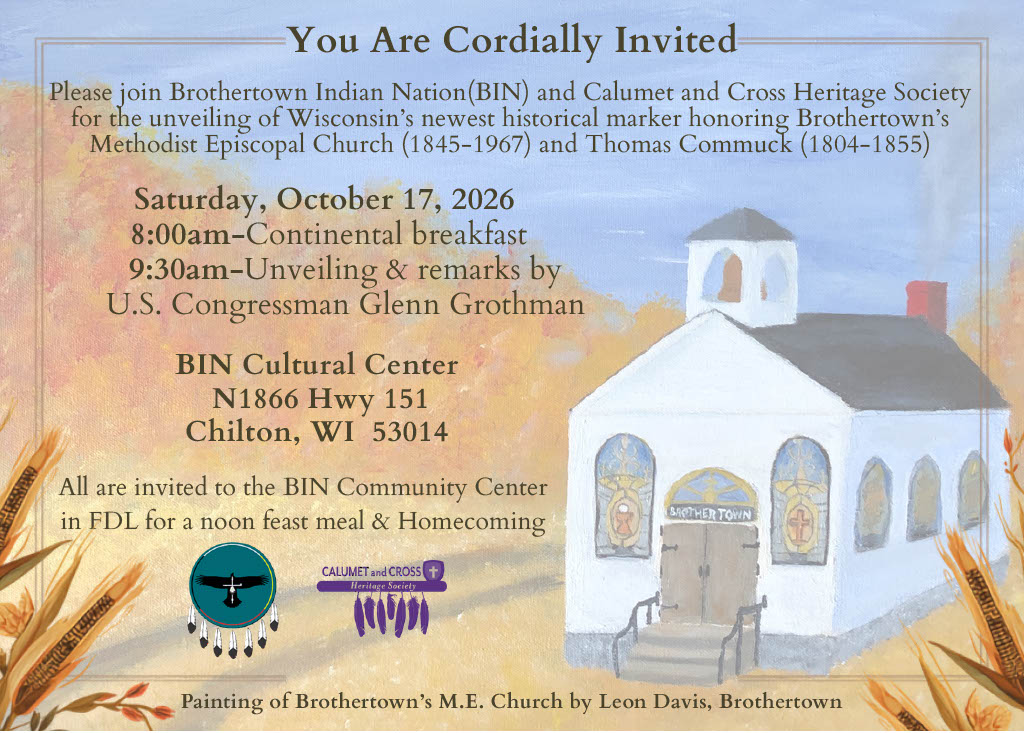
On Saturday, October 17, 2026, a dual-sided historical marker erected by the Wisconsin Historical Society (WHS) will be unveiled in Brothertown by the Honorable Glenn Grothman, U.S. Representative for Wisconsin’s 6th District. The marker, which will be installed on a parcel of original reservation land owned by the Brothertown Indian Nation, honors Brothertown’s Methodist Episcopal Church on one side and composer Thomas Commuck (Narragansett-Brothertown) on the other.
For over 120 years, the Methodist Episcopal Church served as a vital community center for local Brothertown Indians and settlers in Wisconsin. Located on the corner of US 151 and County Road H, Brothertown Indians gathered at the church for religious services as well as to conduct town business. The original log cabin chapel and parsonage were built by tribal members in 1842. In 1845, in need of a larger structure, a “logging bee” was held and a new frame church was constructed. The building underwent extensive remodeling in 1906 but by the 1950s, as the congregation dwindled, the church fell into disrepair and was eventually razed in 1967. The church’s iron bell is now in use at the Oneida United Methodist Church on the Oneida Reservation, while the large stained-glass windows found a home with the Calumet County Historical Society.
The other side of the marker commemorates Thomas Commuck, a Brothertown Indian of Narragansett descent and leader in the Brothertown community. In 1842, Commuck provided three acres from his property for the construction of the Methodist Episcopal Church. He and his wife, Hannah Abner (Pequot-Brothertown), were early church members. Commuck became the area’s first postmaster and served as a Justice of the Peace. He was also a self-trained musician and his “Indian Melodies” (1845) was the first publication in the U.S. by a Native composer using Euramerican musical notation and the first Wisconsin publication to use shape notes. In the 1850s, Commuck wrote short histories of Calumet County and the Brothertown Indians for the Wisconsin Historical Society and local newspapers.
This marker was made possible by a grant from the Pomeroy Foundation through the State Historical Marker program at the Wisconsin Historical Society. Calumet and Cross Heritage Society submitted the application in collaboration with the Brothertown Indian Nation and the Town of Brothertown.
The Brothertown Indian Nation is headquartered in Fond du Lac, Wisconsin. As a treaty tribe, the Brothertown were federally recognized until 1839 when their government-to-government status was terminated by a Congressional Act.The Brothertown Indian Nation has been actively pursuing federal restoration for the past five decades and is currently working with representatives in both the Senate and House of Representatives to introduce a Restoration Bill in Congress to reestablish Brothertown’s nation-to-nation relationship with the United States.
0 Comments